Booking.com: Beyond Complaints, the Vision of an AI-Driven "Strategic Partner".

In the dynamic digital tourism scenario, the relationship between large booking platforms and accommodation providers is under constant scrutiny. At Booking.com, however, the narrative it wants to build is clear and forceful: that of a "strategic partner". Pilar Crespo, Booking's manager for Spain and Portugal, emphasises a collaboration of 20 years in the country, a period which, according to his vision, has been of joint commitment and growth with the Spanish hotel sector. The company argues that its platform has been a "channel of support and growth", denying prejudice and emphasising the voluntariness of the accommodation to become part of their ecosystem.

This "voluntary 100% model" positioning is a fundamental pillar in its defence. Booking.com emphasises that establishments have the absolute freedom to choose the distribution model that best suits their needs, with conditions that they consider "reasoned, reasonable and consistent" with respect to the value they provide.

On regulatory challenges, Booking.com's position is firm. The company disagrees with the recent Swiss rulingwhich orders them a reduction of 25% of its commissionsand has already announced that will appeal and exhaust all legal avenues. Similarly, with regard to the fine of 413 million imposed in Spain due to competition concerns, Booking.com has appealed in October and has obtained the the National Court's decision to stay the case. This means that, for the time being, the fine does not have to be paid or its conditions applied, and the final decision could take three to four years, in what is expected to be a lengthy legal process.

Beyond litigation, Booking.com focuses on the value it brings to its employees. They highlight the global exposure They are attracting strong international demand that individual hotels would find difficult to capture. They underline their technological leadership, with the artificial intelligence as a "bulwark" of its strategy. In the coming weeks, the company will launch AI-driven developments for consumers and partners. Booking CEO Glenn Fogel has already signalled the use of GenAI to suggest answers to travellers' questions, and the development of an AI-powered Partner Assistant to facilitate onboarding new partners. Intelligent filters, property Q&A, and AI-based review summaries are also being implemented. Additionally, the KAYAK team, part of the group, has launched KAYAK.ai, an AI-powered feature test lab to make the product more personalised. Collaboration with leaders in generative AI such as OpenAI, Microsoft (Copilot Actions) and Amazon (Alexa+) is part of this vision.

The company is conceived as a "data driven 100%", using real-time data analysis (device segments, nationalities, etc.) to understand the needs of customers and partnersThe company's distribution network can provide additional value in the distribution. With 200 people in Spain and eight officesThey also emphasise the value of the human team and the close treatment as a differentiator.

In Booking.com's vision, the "tourism of the future" will be profoundly transformed by technology and artificial intelligence, making content viewing more efficient and engaging for new generations of travellers. The world of distribution, although fragmented, offers ample choice and competition is seen as a "good thing" that benefits the customer and allows accommodations to choose the distributor that best suits their strategies and results. Booking.com is committed to continuing to actively evolve and deliver value to the traveller and the property.

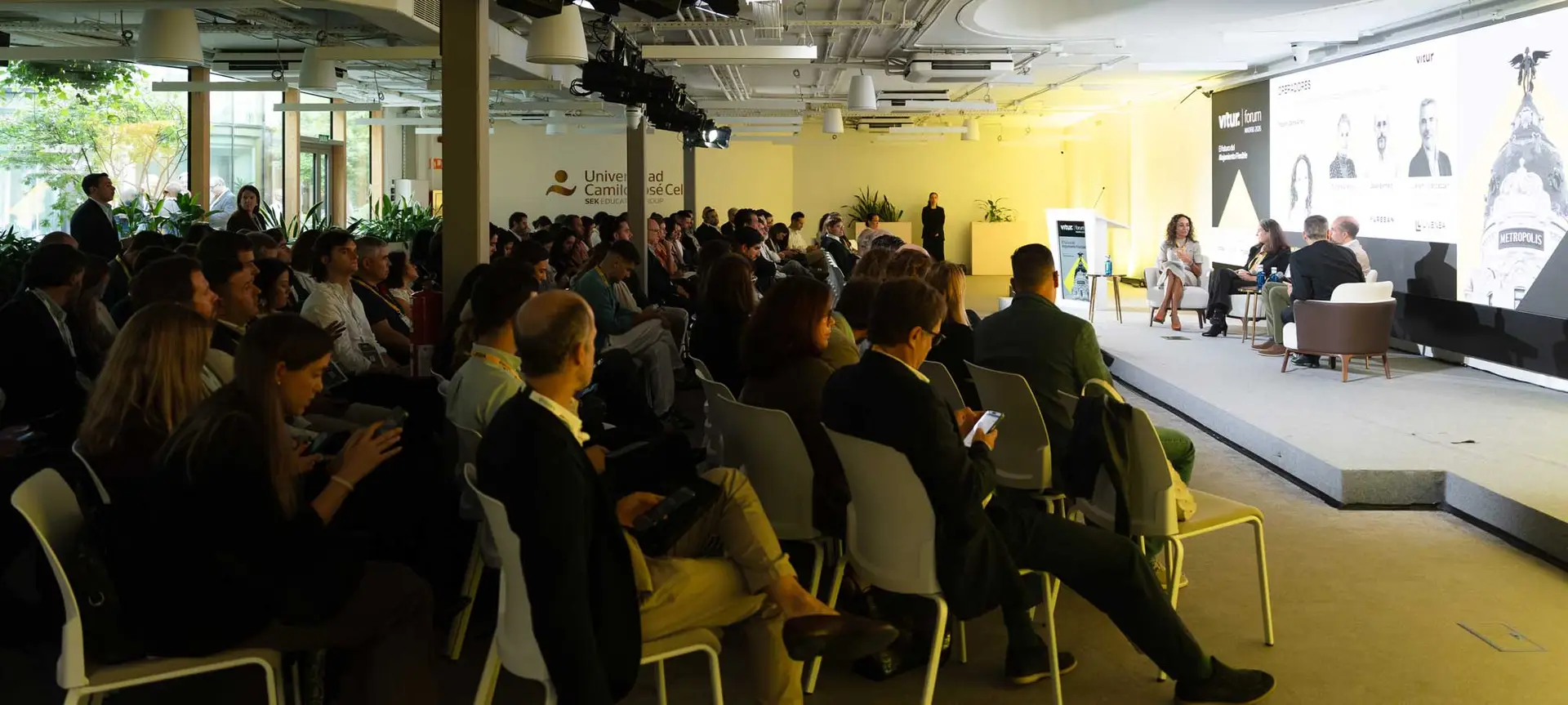
The next Vitur events will be held in Madrid el 15 de octubre and in Seville on November 26th, and will once again be the meeting point for operators, investors and companies in the sector to boost their business, establish strategic alliances with the various stakeholders involved and access all the news, trends and opportunities in the sector from leading speakers and companies.

Continue reading

Detalle de un cuadro eléctrico y contadores modernos en el cuarto de instalaciones de un edificio residencial, ilustrativo de la digitalización de la gestión de suministros
Cuatro Proptech Atacan lo que la Promoción Sigue Haciendo a Mano: Suministros, Preventa, Liquidez Sénior y Grietas
El Clúster de la Edificación, Asprima y la Universidad Politécnica de Madrid reunieron a cuatro compañías tecnológicas que no venden vivienda, sino que arreglan procesos internos del sector. Zenova digitaliza los suministros, Framearq lleva la realidad virtual a la preventa, Jubenial busca liquidez para el propietario mayor y Feelbat monitoriza estructuras con sensores.
Calle de un desarrollo urbano reciente en el norte de Madrid con bloques residenciales contemporáneos, aceras anchas y arbolado joven, ilustrativa del ecosistema de Alojamiento Flexible de Valdebebas
Valdebebas Reúne 5.641 Unidades de Alojamiento Flexible y Seis Operadores: Apenas el 28% Está en Explotación
El barrio del norte de Madrid concentra 5.641 unidades operativas o en desarrollo, según el departamento de Advisory de Activum. De ellas, apenas 1.603 funcionan ya: por cada unidad en explotación hay dos y media en obra. Seis operadores conviven en el mismo ámbito, algo que no ocurre en ningún otro punto de España.
Vista aérea de una gran ciudad española con bloques residenciales y grúas de obra, ilustrativa del volumen de inversión en el mercado living español
El Multifamily Acapara el 78% del Living Español: al Alojamiento Flexible le Llegan 425 de 4.593 Millones
El informe Snapshot de Living de Colliers cifra en 4.593 millones de euros la inversión del primer semestre en España. El multifamily se lleva 3.560, las residencias de estudiantes 608 y el Alojamiento Flexible 425. España invierte a un ritmo del 323% de su media de los últimos cinco años, frente al 85% europeo.
Edificio de oficinas de mediados del siglo XX en el barrio de Salamanca de Madrid en proceso de reconversión en estudios de Alojamiento Flexible
Simplifika Convierte unas Oficinas Obsoletas del Barrio de Salamanca en Alojamiento Flexible bajo el Modelo de Limehome
El proyecto MA18 transformará un edificio de 1.166 metros cuadrados en la calle Maestro Alonso, vacío y funcionalmente agotado como oficinas, en estudios de alto standing repartidos en cinco plantas. Operará con el sistema digitalizado de Limehome, que automatiza el registro y el acceso de los huéspedes.
Edificio urbano de apartamentos con servicios vacío al anochecer, ilustrativo del cese de operaciones del operador Sonder y la venta de su marca
De Sonder Solo Queda el Nombre: TravelAI Compra la Marca sin Edificios, sin Contratos y sin Equipo
La canadiense TravelAI se ha quedado con las marcas registradas y los dominios de Sonder, pero no con sus edificios, sus contratos de arrendamiento, su inventario ni su plantilla. El operador de apartamentos con servicios liquidó su negocio en noviembre, después de que Marriott rompiera el acuerdo de licencia que los unía.
Balcones de un edificio de apartamentos turísticos en una ciudad andaluza, ilustrativos del debate fiscal sobre el IVA aplicable al alojamiento profesional
Las Patronales Andaluza y Catalana Cierran Filas contra el IVA del 21%: Reclaman el Mismo Trato Fiscal que los Hoteles
AVVAPro y Federatur han formado un frente común contra la subida del IVA al 21% que el Gobierno ha aplazado a septiembre por falta de apoyos parlamentarios. Junto a otras asociaciones suman el 60% de la oferta profesional de España y reclaman el mismo trato fiscal que los hoteles, que tributan al 10%.